The Conversation
17 Jul 2025, 17:23 GMT+10
Share article
Copy article link
Print article
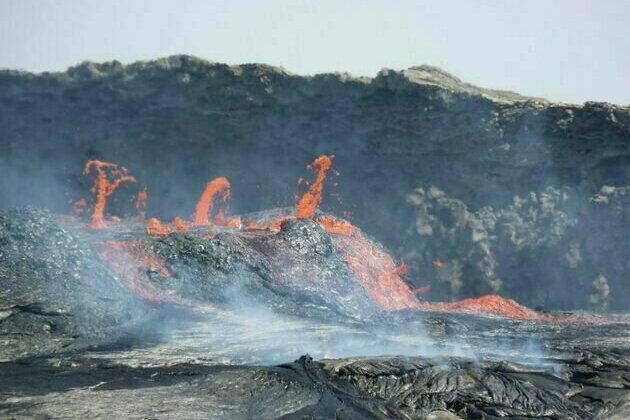
Earth's continents may look fixed on a globe, but they've been drifting, splitting and reforming over billions of years - and they still are. Our new study reveals fresh evidence of rhythmic pulses of molten rock rising beneath east Africa, reshaping our understanding of how continents break apart.
Our findings could help scientists understand more about volcanic activity and earthquakes.
There are around 1,300 active volcanoes on the Earth's surface. Active volcanoes are those thought to have had an eruption over the last 12,000 years or so. Of these volcanoes, over 90 lie on the East African Rift Valley - the seam along which Africa is splitting apart. This weak seam of crust may even allow a new ocean to form over the next few million years.
Although ocean formation is happening around the world, and has been for several billion years, there are few places on Earth where you can study different stages of continental breakup at the same time. This is because they normally become submerged under water as the Earth's crust thins, and seawater eventually inundates the rift valley.
Get your news from actual experts, straight to your inbox. Sign up to our daily newsletter to receive all The Conversation UK's latest coverage of news and research, from politics and business to the arts and sciences.
The Rift Valley is different. There is, at its northern end (in Ethiopia) a place called Afar, which sits at the meeting point of three rifts. These are called the Red Sea Rift, the Gulf of Aden Rift, and the Main Ethiopian Rift (see the map below).
The Red Sea Rift has been spreading for the last 23 million years, and the Main Ethiopian Rift for the last 11 million years. There are active volcanoes across all three of these rifts. In Afar, all three rifts are at least partly exposed, with the Red Sea Rift and Main Ethiopian Rift having the most exposure.
Volcanic rocks that erupt when Earth's tectonic plates spread apart provide a window into the inner Earth that wouldn't otherwise be accessible. Each lava flow and volcano has its own story that is recorded in the rock and we can learn about that through geochemistry - the concentrations of the elements that make up the rock - and mineralogy - the minerals within the rock.
Analysing these things can tell us about the depth at which the melting rock formed and roughly where in the Earth's mantle it formed. In our new study, we analysed over 130 new lava samples, obtained from the Afar rock repository at the University of Pisa and our own fieldwork.
We used these samples to investigate the characteristics of the mantle beneath this rifting, when tectonic plates are moving apart from each other. These samples are from Holocene eruptions (rocks younger than 11.7 thousand years old) from across Afar and the East African Rift.
Since the 1970s, scientists have believed that there is a mantle plume beneath the Afar region. Mantle plumes are a portion of abnormally hot mantle (around 1,450C) or unusual composition of the mantle (or both) below the Earth's surface. Scientists think it pushed some of the mantle to the Earth's surface. Our study not only confirms the presence of a mantle plume in this region, but also gives scientists details about its characteristics.
We discovered that the mantle plume beneath the region rises beneath the tectonic plates in pulses, and the pulses have slightly different chemical compositions.
There are mantle plumes around the world. They can be identified in the geological record as far back as several billion years. Each of the plumes has different characteristics - with their own unique chemical composition and shape.
One mantle plume still active today is the one lying below the Hawaiian islands. These islands are part of the Hawaiian Emperor chain, formed over the last 80 million years or so, and are still forming today. The islands originate from the Pacific tectonic plate slowly moving across the top of a mantle plume, making lava bubble up, erupt and eventually solidify as rock.
This plume melts the Earth's mantle and forms magma, which over long periods results in the formation of an island chain or breaks up continents. It can also form volcanoes along a rift in the Earth's crust, as we see in east Africa. The Hawaiian plume signature comes from two chemical compositions rising up through the mantle together like two vertical strands.
While scientists have long thought there probably is a plume underneath Afar, what it looks like is debated.
In our study, we created several scenarios of what the plume looks like and then used mathematical modelling to see which plume scenario best fit the sample data. Using this data-driven approach, we show that the most likely scenario is a singular plume that pulses with different chemical compositions.
The three rifts in Afar are spreading at different rates. The Red Sea Rift and Gulf of Aden Rift are moving faster at about 15mm per year (that's half the rate your fingernails grow at) compared to the Main Ethiopian Rift moving at about 5mm per year. We deduced that the pulses are flowing at different speeds along the stretched and thinner undersides of the tectonic plates.
All this shows us that the motion of tectonic plates can help focus volcanic activity to where the plate is thinner.
This finding has important implications for how we interpret volcanic and earthquake activity. It may indicate that volcanism could be more likely to occur in the faster spreading and thinner portions of the rift, as the flow beneath replenishes the magma more frequently.
However, the eruptions here may be less explosive than the slower spreading rifts. This fits observations that explosive eruptions occur more frequently in the Main Ethiopian Rift (which sits on a thicker part of the plate and where the volcanoes are more mature), compared to the Red Sea Rift.
Our understanding of the link between continental rifting and mantle plumes is still in its infancy but research is already providing insights into how tectonic plates affect mantle plumes and how this might be recorded in the future seafloors of Earth.
Get a daily dose of Kenya Star news through our daily email, its complimentary and keeps you fully up to date with world and business news as well.
Publish news of your business, community or sports group, personnel appointments, major event and more by submitting a news release to Kenya Star.
More Information(250717) -- BEIJING, July 17, 2025 (Xinhua) -- People view robots at the pavilion of Shandong Province during the third China International...
(Photo credit: Susan Mullane-Imagn Images) World No. 1 Aryna Sabalenka has decided not to play in the Canadian Open, citing fatigue....
DURBAN, 17th July, 2025 (WAM) -- The UAE, represented by the Ministry of Finance and the Central Bank of the UAE, is participating...
Johannesburg (South Africa), July 17 (ANI): Cricket South Africa (CSA) has announced the appointment of Patrick Moroney as the new...
Share article Copy article link Print article Earth's continents may look fixed on a globe, but they've been drifting, splitting...
(250717) -- BEIJING, July 17, 2025 (Xinhua) -- Chinese Vice President Han Zheng meets with South African Deputy President Paul Mashatile...
The Gaelic Games in Palestine (GAA-P) organization has filed an official appeal after Irish authorities denied travel visas to its...
LONDON, U.K.: American consumers and businesses could soon face the highest overall tariff burden in more than a century, according...
Dhaka [Bangladesh], July 17 (ANI): The Bangladesh Cricket Board (BCB) on Thursday announced the squad for the upcoming three-match...
Former first deputy prime minister and economy minister Yulia Sviridenko has replaced Denis Shmigal Ukraine's parliament, the Verkhovna...
Washington [US], July 17 (ANI): US President Donald Trump on Wednesday dismissed calls for appointing a special counsel to investigate...
Alexus Grynkewich has pledged to expedite a scheme under which Germany will buy the US-made surface-to-air missile systems for Kiev...